How Online Access Is Redefining Hindi Cinema
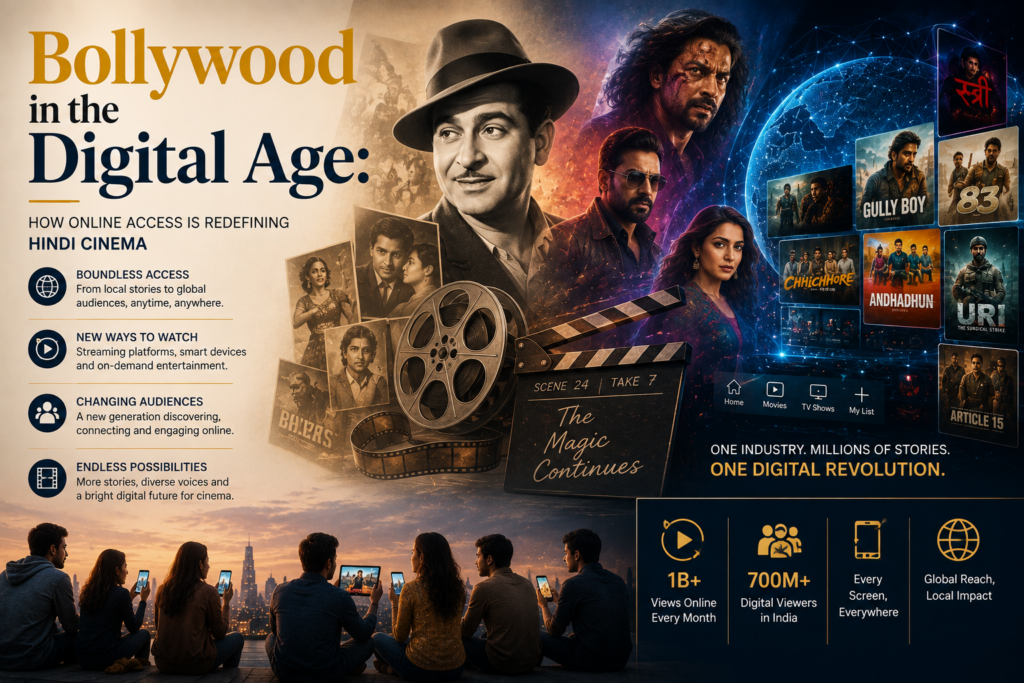
Bollywood is entering a period in which theatrical cinema, streaming, social discovery, and mobile viewing increasingly operate as parts of the same entertainment ecosystem. Hindi films continue to attract a substantial theatrical audience, but the journey from discovering a title to actually watching it is no longer tied to a cinema timetable or television schedule. For viewers interested in बॉलीवुड मूवी ऑनलाइन , the digital catalog offers a more flexible way to explore Hindi cinema, moving directly from browsing to playback whenever the viewer chooses.
A Cinema Audience That Lives Between Screens
The modern Bollywood audience is remarkably connected to digital media. Research from Ormax Media’s 2026 Bollywood Audience Report identifies approximately 28.5 million regular Hindi theatrical viewers aged 15 and above in urban India. The research also examines how audiences discover films and how their media habits are changing around theatrical entertainment.
This is important because the contemporary movie experience often begins before a viewer enters a theater or opens a streaming player. Online video, social media, search, and digital ticketing have become important touchpoints in film discovery. YouTube and Instagram, in particular, have emerged as influential channels for Hindi cinema audiences.
The distinction between “cinema audience” and “streaming audience” is consequently becoming less straightforward. A viewer can discover a Hindi film online, watch it theatrically, encounter another title through a streaming recommendation, and later return to a digital catalog. Bollywood increasingly exists across all of these screens rather than being confined to one viewing environment.
The Digital Shelf Has Become a New Cinematic Space
A traditional movie collection was limited by physical ownership. DVDs occupied shelves, television channels controlled schedules, and local cinemas determined which films could be seen in a particular city. Streaming replaces many of those limitations with a digital shelf that can contain a far broader selection.
This changes the role of the catalog. It is no longer simply a place where films are stored. It becomes a discovery environment where genres, collections, recent additions, and search functions help viewers navigate Hindi cinema according to their own interests.
This is particularly useful for Bollywood because the Hindi film ecosystem covers a wide range of genres and production styles. A viewer may be interested in comedy on one occasion and suspense, drama, romance, action, or family entertainment on another. A digital catalog can accommodate those changing preferences without requiring the viewer to wait for a particular program.
The result is a more personal relationship with Hindi cinema. Instead of asking what is being shown at a particular moment, the viewer can ask what fits the moment.
Theatrical Cinema and Streaming Are Becoming Partners
The growth of streaming has not eliminated the importance of theatrical releases. Instead, the two formats have become increasingly interconnected. Ormax Media’s analysis of streaming rights for 126 theatrical films released in India during 2025 found that theatrical films remained important drivers of customer acquisition for subscription streaming platforms.
This relationship gives Hindi films a longer digital life. A theatrical release establishes an initial audience, while later streaming availability creates another opportunity for discovery. Someone who missed the cinema release can eventually encounter the film online, while another viewer may simply prefer the convenience of watching at home.
The distinction is particularly relevant internationally. A Hindi film may receive extensive theatrical distribution in India but have a much smaller cinema presence in another country. Online availability can provide international audiences with another route into contemporary Bollywood.
Streaming therefore works less as a replacement for theatrical cinema and more as an additional stage in the modern distribution cycle.
Why Discovery Matters as Much as Availability
A large collection does not automatically create a good streaming experience. If hundreds or thousands of titles are presented without meaningful organization, viewers can spend more time searching than watching.
Digital discovery tools address this problem by giving audiences different ways into the catalog. Search supports viewers who already know what they want, while genre shelves and curated collections help those who arrive without a specific title in mind.
The importance of digital discovery is now recognized throughout the Indian film industry. Ormax’s 2026 research specifically examines the influence of digital media on Hindi-film discovery and theatrical behavior, reflecting how closely online activity has become connected with the broader movie ecosystem.
For an online Bollywood catalog, this means navigation should feel intuitive rather than technical. A viewer should be able to move between sections naturally, discover something unexpected, and return to the main shelf without losing the thread of the browsing experience.
A More Direct Route From Choice to Playback
The quality of a streaming service becomes particularly obvious once the viewer has made a decision. Registration walls, repeated redirects, intrusive advertising, and unnecessary pop-ups can turn a simple viewing choice into a frustrating process.
Moviewala’s approach keeps the interaction centered on the catalog. Viewers can browse Hindi entertainment, select a title directly from the shelf, and move toward playback without a mandatory sign-up wall. The absence of annoying pop-ups also keeps the interface visually clean and allows the content itself to remain the focus.
This direct model is useful for exploratory viewing. A viewer can open one title, return to the catalog, examine another section, and make a different choice without repeatedly encountering barriers.
The principle is simple: the catalog should help the viewer decide what to watch, not make the viewer work to reach it.
Bollywood Across the Screens of Everyday Life
Streaming has also changed the physical setting of movie consumption. Smart televisions provide a large-screen experience at home, while laptops and desktop computers remain useful for personal viewing. Tablets and smartphones have made digital entertainment increasingly portable.
India’s connected-TV market is expanding alongside smartphone-based streaming. Industry data cited in 2026 indicates that the country had approximately 129 million connected-TV users in 2025, while its overall streaming audience reached around 601 million users.
For Bollywood, this creates a genuinely multi-screen audience. The same viewer may use a smartphone for discovery and a Smart TV for longer viewing, while another may prefer to stay entirely on a laptop.
A modern catalog therefore needs responsive design. Shelves, search tools, navigation, and playback controls should remain comfortable regardless of screen size. The viewer should experience continuity rather than feeling as though every device represents a separate service.
The Technology Behind Smooth Hindi Film Streaming
The apparent simplicity of online playback depends on a sophisticated technical infrastructure. High-resolution movies contain large amounts of data, requiring efficient compression and delivery systems capable of serving audiences across different networks and geographic locations.
Cloud infrastructure and content delivery networks help distribute media efficiently, while adaptive streaming can respond to changes in available bandwidth. These technologies allow a platform to balance image quality with data requirements and maintain a more consistent viewing experience when network conditions fluctuate.
This infrastructure becomes particularly important for Bollywood because its audience extends far beyond India’s major metropolitan areas. Hindi cinema can be accessed by viewers in the Gulf, Europe, North America, Southeast Asia, and many other regions.
The technical systems should remain invisible to the viewer. When they work properly, audiences simply select a film and receive stable, high-quality playback without needing to understand what is happening behind the player.
Bollywood Is Part of a Larger Indian Streaming Culture
Hindi cinema remains one of the strongest categories within India’s entertainment market, but digital platforms have also created greater visibility for regional-language industries. Telugu, Tamil, Bengali, Malayalam, Marathi, and other Indian-language productions increasingly occupy their own spaces within streaming catalogs.
This broader environment changes how Bollywood is discovered. A viewer may enter a platform looking for Hindi cinema and later explore another Indian language because the catalog makes those connections easy to see.
The development of Ormax StreamView is itself evidence of how sophisticated India’s streaming market has become. Launched in 2026, the system tracks long-form content across OTT originals, theatrical films, television programming, non-fiction, sports, and news, reflecting an increasingly unified view of what Indian audiences watch online.
For viewers, the practical consequence is greater choice. Bollywood remains a major cinematic identity while becoming part of a much wider digital map of Indian entertainment.
The Long Tail of Hindi Cinema
Digital catalogs also change the lifespan of films. Traditional television schedules and theatrical runs give titles limited periods of prominent visibility. Online libraries can keep films discoverable for much longer, allowing audiences to encounter productions according to their own timing.
This is particularly relevant because Hindi cinema is not defined only by its biggest releases. Ormax’s industry research has identified a broader recovery in India’s box office, with the dependence on the ten highest-grossing films declining from 41% in 2024 to 33% in 2025.
A broader market creates more opportunities for digital catalogs to support discovery beyond the most heavily promoted titles. Viewers can explore different periods, genres, and styles instead of concentrating exclusively on the films receiving the largest marketing campaigns.
In this sense, streaming can function as a form of cultural archive as well as a source of current entertainment.
Where Online Bollywood Viewing Is Heading
The future of Hindi cinema is unlikely to be defined by a simple choice between theaters and streaming. The two environments increasingly complement one another, while digital discovery influences how audiences learn about films and decide what they want to watch.
As catalogs become larger, the importance of intuitive organization will continue to grow. Better search, personalized discovery, multilingual interfaces, responsive design, and more efficient delivery infrastructure can make extensive Hindi collections easier to explore without adding complexity.
For the audience, the most important change is control. A viewer can discover Bollywood through digital channels, browse a catalog according to personal interests, choose a device that fits the moment, and begin watching without organizing the evening around a fixed schedule.
The experience can remain deliberately simple. Open the Moviewala Hindi catalog, explore the available Bollywood shelves, select a title directly, and press play. With high-quality playback, one-click access, no registration wall, and no distracting pop-ups, the technology can stay quietly in the background while Hindi cinema remains at the center of the experience.